First-Party & Zero-Party Data: Data Strategies in the Privacy Era
Recognize the differences between first-party and zero-party data, their benefits, as well as the role of GDPR and the elimination of third-party cookies in shaping digital marketing strategies that are safer, more transparent, and more effective.
Data is an essential asset in digital marketing strategies. For years, companies relied on third-party cookies to understand user behavior across various websites. However, the growing public awareness of privacy and regulations such as the General Data Protection Regulation (GDPR) have transformed the way companies collect and process user data (Twilio, 2022; NISO, 2023).
The focus has now shifted to first-party data and zero-party data: two types of data collected directly from customers, considered more accurate, relevant, and compliant with regulations. This article discusses the definition, differences, benefits, as well as strategies for implementing these two types of data to help businesses prepare for a cookie-less world.
What Are Third-Party Cookies?
Third-party cookies are small files placed by third parties (not the site owner) to track user activity across different platforms. This practice has long been the backbone of targeted digital advertising. However, cross-site data collection is considered invasive, prompting major browsers such as Safari, Firefox, and Chrome to discontinue support (Twilio, 2022).
The elimination of third-party cookies marks the end of an era of advertising reliant on third-party data and forces businesses to seek new, more ethical ways to understand customers.
What Is GDPR?
The General Data Protection Regulation (GDPR) is a European Union regulation governing how organizations collect, process, and store users’ personal data. GDPR came into effect on May 25, 2018, and was born as a response to public concerns about data misuse, information leaks, and the lack of user control over personal data (NISO, 2023).
GDPR requires companies to obtain explicit consent, provide users with access and deletion rights, and ensure transparency in data processing. This regulation has become a global benchmark and encourages businesses worldwide to establish more ethical and secure data management practices.
What Is First-Party Data?
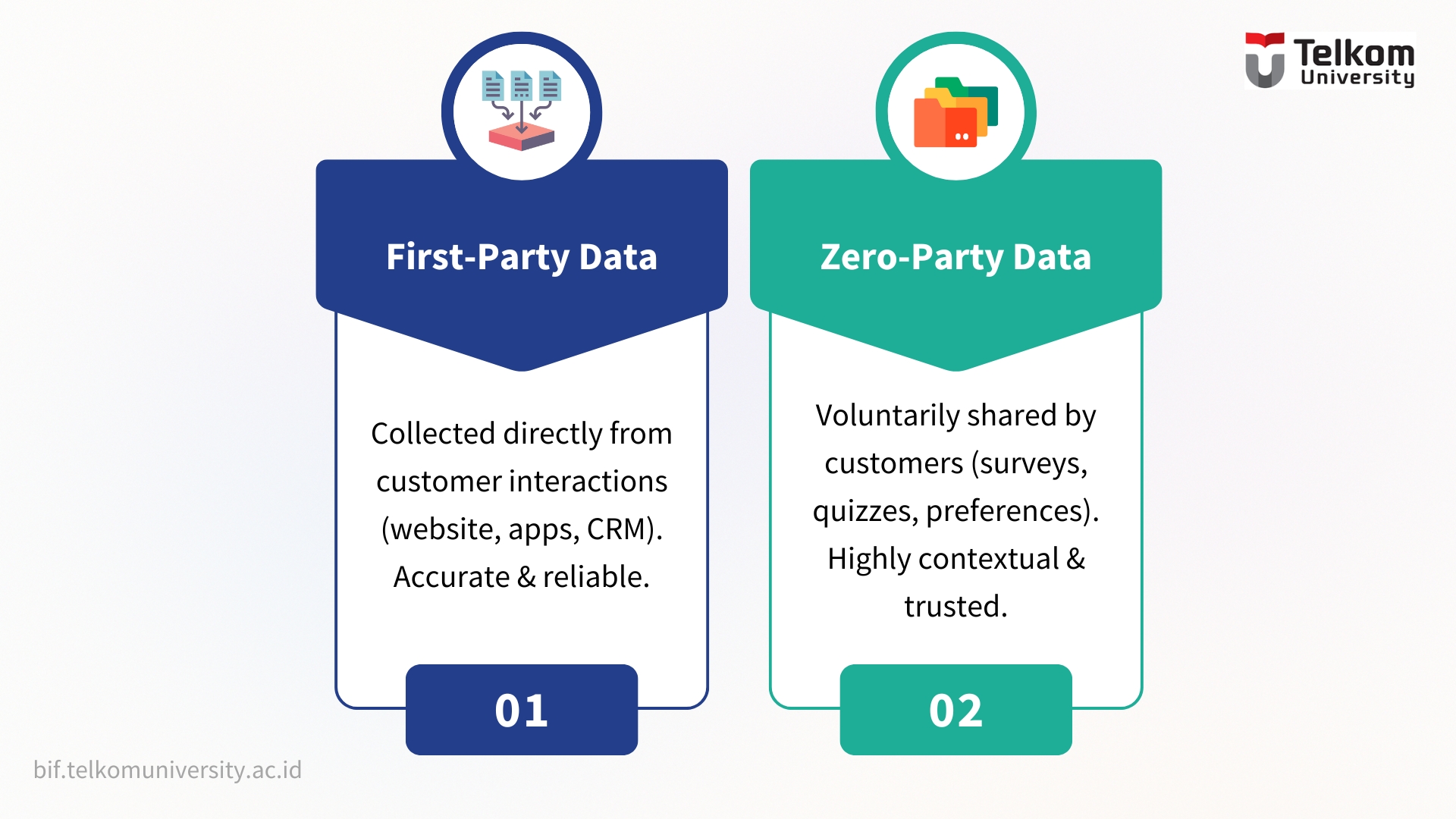
First-party data is information collected directly by a company from customer interactions on their owned platforms, such as websites, applications, emails, or CRM systems. This data includes purchase history, page clicks, email engagement, and customer profile data (Twilio, 2022).
Because it is obtained directly from customers, first-party data is more accurate and relevant. Strategies based on first-party data help businesses gain a deeper understanding of customer behavior without having to rely on third parties.
First-party data is the “secret weapon” for creating precise and personalized audience segmentation. Instead of only analyzing click patterns or purchase history, businesses can use this data to understand customers’ real preferences. With the right strategy, first-party data helps build long-term relationships, increase loyalty, and make marketing campaigns more effective (WebFX, 2023).
What Is Zero-Party Data?
Zero-party data is information voluntarily and consciously provided by customers. Examples include survey answers, quiz results, product preferences, and data shared through preference centers (Shopify, 2023).
Since customers willingly provide this data, zero-party data is considered highly accurate and rich in context. This data allows companies to build deeper personalization and enhance customer trust in the brand.
Differences Between First-Party and Zero-Party Data
| Aspect | First-Party Data | Zero-Party Data |
|---|---|---|
| Collection Method | Passive: obtained from customer behavior & interactions | Active: explicitly given by customers |
| Engagement Level | Medium | High |
| Accuracy | High | Very high |
| Example | Page clicks, transaction history, email engagement | Survey answers, product preferences |
Why Is It Important in the Cookie-less Era?
The shift to a cookie-less world requires companies to rely on directly owned data. According to Twilio (2022), although 81% of companies still use third-party cookies, trends indicate an increase in investment in strategies based on first-party data.
This approach not only reduces legal risks but also builds more personal, trust-based customer relationships. The combination of first-party and zero-party data becomes a long-term solution for businesses in the privacy era.
Benefits of Using First- & Zero-Party Data
More Accurate Personalization
According to NISO (2023), companies can use this data to deliver product recommendations, relevant search results, and more personalized marketing messages.
Enhancing Customer Trust
Zero-party data helps businesses foster transparency and loyalty because customers feel safe sharing their information (Shopify, 2023).
Cost and Strategy Efficiency
Relying on internal data reduces dependence on third parties while lowering marketing costs through more accurate targeting.
Data Collection Strategies
A. Collecting First-Party Data
- Using website analytics to track user behavior.
- Integrating Customer Relationship Management (CRM) systems to store customer interactions (name, contact information, purchase history, email interactions, preferences) into one platform so companies can:
- Understand customers more deeply.
- Provide more personalized services.
- Create more targeted marketing strategies.
- Measuring email engagement such as open rates and link clicks.
B. Collecting Zero-Party Data
- Offering quizzes or surveys with incentives.
- Providing access to preference centers for personalization.
- Using interactive polls to encourage participation.
Case Study: L’Oréal Routine Finder
L’Oréal used the “Routine Finder” quiz to collect zero-party data voluntarily. This strategy increased the average order value by up to 134%, proving that customers appreciate transparency and data-driven personalization (Shopify, 2023).
Conclusion
The elimination of third-party cookies and the emergence of regulations such as GDPR mark a major shift in digital marketing strategies. GDPR, which has been in effect since 2018, was introduced as a response to concerns about data misuse and information leaks, driving global transparency practices.
Companies that rely on first-party and zero-party data not only comply with regulations but also build stronger, more personal, and trust-based customer relationships. With proper internal data management, businesses can create relevant and long-term valuable customer experiences.
Learn more about data-driven marketing strategies at Telkom University. Discover the latest insights on digital marketing, data analytics, and technological innovation to support your business transformation.
References
Shopify. (2023). Zero-party data vs. first-party data: What’s the difference? Shopify. Retrieved September 2, 2025, from https://www.shopify.com/id/enterprise/blog/zero-party-data-vs-first-party-data
Twilio. (2022). A cookieless world is coming. State of Customer Engagement Report. Retrieved September 2, 2025, from https://www.twilio.com/en-us/state-of-customer-engagement/2022/trend-3
National Information Standards Organization (NISO). (2023). The role of zero- and first-party data in personalization. NISO I/O. Retrieved September 2, 2025, from https://www.niso.org/niso-io/2023/05/role-zero-and-first-party-data-personalization
Data Insights Channel. (2023, April 10). How to master first-party data: Your secret weapon for targeted marketing [Video]. YouTube. https://youtu.be/VoQzRI7oB7I
Author: Junianda Haris Dwiagam | Content Research & Editor: Meilina Eka Ayuningtyas


